
Lip Service: The Past, Present & Future of American Oral Tobacco & Nicotine Pouches
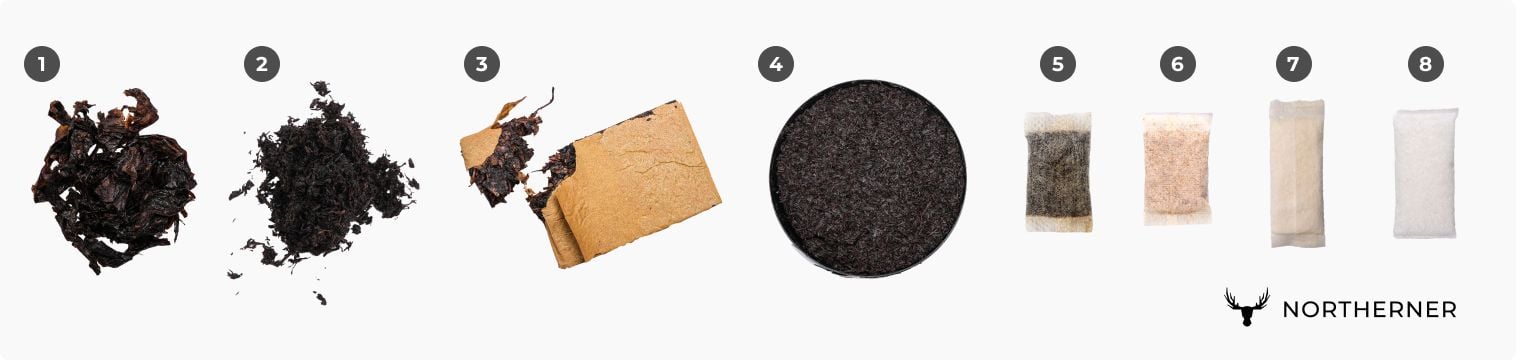
Key Takeaways
- Chewing tobacco (1-3) and snuff (4) are declining but still used in rural areas—both carry high health risks.
- Swedish snus (5) offers a spit-free, lower-risk alternative.
- Nicotine pouches (6-8) are growing in popularity and may be the lowest-risk option—though long-term effects are still unknown.
- All products contain nicotine, which is dependence forming.
Oral tobacco and nicotine products have a long, storied history in America, evolving from rugged chew to tobacco leaf-free pouches. Chewing tobacco dominated the scene until the end of the 19th century but waned in popularity after mass-produced cigarettes entered the marketplace.
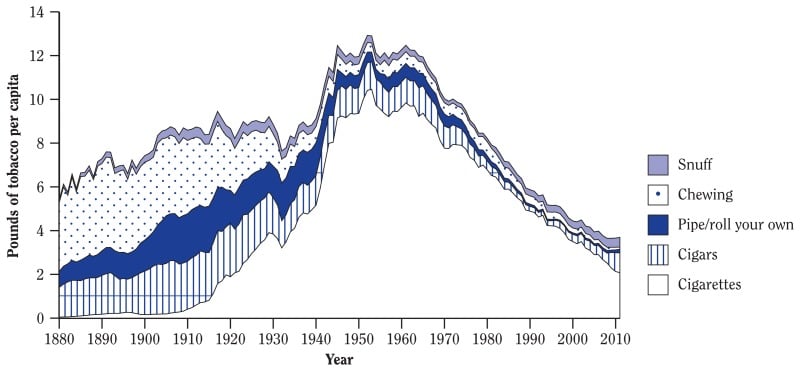
Per capita consumption of different forms of tobacco in the United States, 1880-2011. Source: The Health Consequences of Smoking—50 Years of Progress: A Report of the Surgeon General.

Response every day or some days to the question: Do you currently use chewing tobacco, snuff, or snus?
*KY and PA percentages are from 2022.
Source: https://www.cdc.gov/brfss/brfssprevalence/index.html.
Today, oral products cater to diverse preferences—whether for tradition, convenience, or harm reduction. Let’s explore the major types, how they’re used, and their health profiles. All of these products contain nicotine, which is addictive, but the processing and product attributes contribute to different health profiles.
Chewing Tobacco (Chew, Images 1-3)
What it is: Loose leaf, plug, or twist tobacco leaves designed to be held in the cheek; moist texture, sometimes flavored.
How it’s used: Users place a wad in the cheek and might chew intermittently, releasing nicotine and flavor. Spitting is required.
Who uses it: Historically popular among farmers, soldiers, and baseball players. President Andrew Jackson was an avid chewer and installed 22 spittoons in the East Room of the White House. Hundreds of spittoons also dotted the U.S. Capitol building until the 1980s.
When it was popular: Peaked in the late 1800s and early 1900s, decreased use in the mid 20th century when cigarettes took over the market, but still used today.
Health profile: Contains tobacco leaf and carcinogens, linked to oral cancers and gum disease.
Chewing tobacco's roots run deep in American culture, intertwining with the nation's history. While the reasons behind its popularity varied, chewing tobacco found its place as a cherished tradition. It’s also really messy.
Moist Snuff (Dip, Image 4)
What it is: Long cut or finely ground tobacco, moist texture, often flavored.
- Long Cut: Long cuts of tobacco leaves that can be easier to pack and position in the mouth.
- Fine Cut: Contains finely ground or shredded tobacco pieces, which allows for tighter packing in the mouth.
How it’s used: A pinch (“dip”) is placed between the gum and cheek. Spitting is common.
Who uses it: Traditionally associated with rural and southern demographics, including young men and athletes.
When it was popular: Rose in popularity in the mid-20th century as an alternative to cigarettes and chewing tobacco.
Health profile: Still tobacco-based, with risk of cancer and oral health issues.
Moist snuff took over chewing tobacco in use. But it’s still messy.
Pouched Snuff (not pictured above)
What it is: Moist snuff packaged in small pouches for cleaner handling.
How it’s used: Placed under the lip, but still requires spitting in most cases.
Who uses it: Consumers seeking convenience without loose tobacco mess.
When it was popular: Became common in the 1980s as a “modernized” dip format.
Health profile: Similar risks to moist snuff, since it is the same product but in a pouch.
Consistent doses and cleaner than pinches but still contains carcinogens.
Swedish Snus (Image 5)
What it is: A pasteurized, moist tobacco product originating in Sweden.
How it’s used: Placed under the upper lip, no spitting required.
Who uses it: Gained some traction among harm-reduction advocates and consumers looking to ditch the spit bottle, but never really took off in the U.S.
When it was popular: Introduced to the US market in the early 2000s; long-standing tradition in Scandinavia since the 19th century, but only packaged in pouches in the 1970s.
Health profile: The pasteurization process reduces microbial activity, which translates into lower nitrosamine levels compared to oral products containing fermented tobacco (chewing tobacco, moist snuff, and pouched snuff). Swedish snus comes in consistent doses and has substantially lower levels of carcinogens than cigarettes or other forms of oral tobacco. The Food & Drug Administration authorized eight snus products to be sold in the U.S. with the following claim “Using [this product] instead of cigarettes puts you at a lower risk of mouth cancer, heart disease, lung cancer, stroke, emphysema, and chronic bronchitis.”
Nicotine Pouches (Images 6-8)
What it is: Pouches containing nicotine (synthetic or from tobacco), plant fibers, flavorings, and stabilizers.
How it’s used: Placed under the lip, completely spit-free.
Who uses it: Rapidly growing among adults seeking smoke-free, tobacco leaf-free alternatives.
When it was popular: First sold in Colorado in 2014 and nationwide in 2019, nicotine pouches are poised to overtake moist snuff as the most sold oral product in the US. They are also increasingly used by U.S. adults who recently quit cigarettes or e-cigarettes.
Health profile: No tobacco-specific carcinogens, regarded as a lower-risk alternative to smoking and chewing tobacco.
From spittoons in the White House to the rise of spit-free pouches, America’s oral tobacco and nicotine story is one of tradition, change, and choice. As old favorites like chew and dip fade, new options are reshaping the landscape, offering cleaner and potentially safer alternatives for those adults who want them.
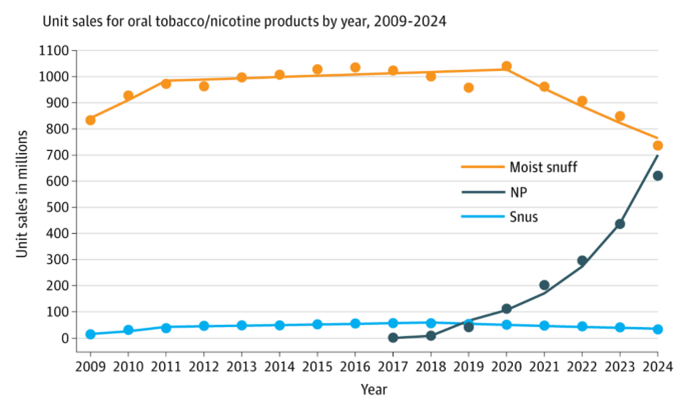
Unit sales for oral tobacco/nicotine pouches by year, 2009-2024. Source: Hrywna et al. (2025) Oral tobacco and nicotine marketplace trends since the tobacco control act. JAMA Netw Open 8:e2540747